성 예로니모
Sanctus Hieronymus · 347년 ~ 420년 9월 30일 · 베들레헴 동굴의 학자 · 라틴어 성경 불가타(Vulgata)의 번역자 · 4대 서방 교회학자
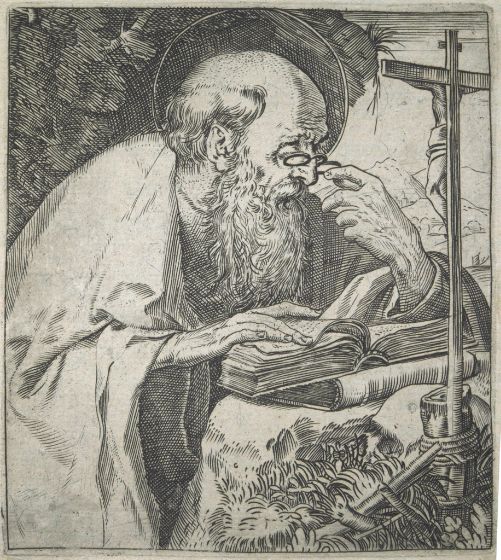
*”라틴어로는 키케로 같고, 그리스어로는 데모스테네스 같다”*
예로니모(Hieronymus — 그리스어로 “거룩한 이름”이라는 뜻)는 347년 달마티아(현재 크로아티아/슬로베니아 경계의 스트리도네) 그리스도교 가정의 아들. 청년 시절 — 로마에서 고전 라틴 문학을 깊이 공부했다.
수사학 교사 도나투스(베르길리우스 주해서의 저자) 밑에서 — 키케로·베르길리우스·호라티우스·테렌티우스를 라틴어 텍스트의 살아 있는 부분으로 익혔다. 그의 라틴어 문장은 — 후대 라틴 교부들 중에서도 가장 우아한 라틴어로 평가된다.
청년기에 그는 — 세속의 영광을 원했다. 법조계와 수사학 강사 자리를 추구. 그러나 — 세례를 받기로 결심한 후 — 그의 마음이 점점 더 그리스도의 길로 기울었다.
*시리아 사막 — 5년의 은수*
373년경, 26세의 예로니모 — 시리아 안티오키아 인근 칼키스 사막(현재 시리아 동부)에서 5년간 은수자로 살았다. 그 시기에 히브리어를 한 유다인 학자에게서 배우기 시작. 서방 학자 중 — 히브리어를 그렇게 깊이 익힌 첫 사람.
*키케로주의자가 아니라 그리스도인이라*
그 사막에서 한 꿈을 꾸었다 — 심판자 앞에 끌려가 “너는 누구냐?” 질문을 받았다. “그리스도인입니다” 답했다. 그러나 심판자가 답했다 — “거짓말이다. 너는 키케로주의자다(Ciceronianus es, non Christianus). 네 마음의 보물은 그리스도가 아니라 키케로다.”
깨어난 예로니모는 — 얼굴이 채찍 자국으로 부어 있었다고 자신이 적었다. 이 꿈 이후 — 라틴 고전 문학을 멀리하고 성경 학자가 되기로 결심했다.
(그러나 사실은 — 그가 평생 키케로 문체를 못 버렸다. 후일 — 키케로 같은 문체로 성경을 번역하는 학자가 되었다. 그의 꿈이 그를 떠나게 한 게 아니라, 방향을 바꾸게 했다.)
*불가타* — *1600년의 표준 성경*
382년 — 교황 다마수스 1세가 예로니모를 비서로 부르고 — 한 큰 사명을 맡겼다. 기존의 옛 라틴어 성경 번역들(Vetus Latina, 여러 사람이 단편적으로 번역한 라틴어 성경)을 — 한 통일된 성경으로 새로 번역하라.
386년부터 예로니모는 — 베들레헴(예수님이 태어나신 마을) 인근 동굴 옆 수도원에 은둔. 30년 이상 — 한 일에만 집중했다.
— 그리스어 신약을 라틴어로 새로 번역 (이전 라틴어 번역과 그리스어 원문을 비교). — 구약은 그리스어 70인역(Septuagint)이 아닌 히브리어 원문(Hebraica veritas)에서 직접 번역. 서방 그리스도교 역사상 — 히브리어 원문에서 직접 번역한 첫 사람.
405년경 — 완성. 이게 — 불가타(Vulgata, “보편적인 것” — vulgus가 백성을 가리키는 데서 온 말).
1546년 트렌트 공의회에서 가톨릭 교회의 공식 라틴어 성경으로 선포 — 1965년 「신新 불가타」(Nova Vulgata)까지 — 약 1600년간 가톨릭 교회의 표준 성경. 루터의 독일어 번역, 영어 King James Bible — 모두가 불가타를 모델로 했다.
*베들레헴 동굴 — 예수님 탄생지 곁에서*
예로니모는 — 386년부터 죽을 때까지 35년간 — 예수님이 태어나신 베들레헴 동굴 바로 옆 수도원에서 살았다. 그곳에서 그가 한 일:
— 불가타 번역 — 30년 이상. — 모든 성경책 강해서. 마태오·갈라티아서·에페소서·시편·이사야·예레미야·예루살렘·다니엘·열두 소예언서·요한묵시록. — 「유명한 사람들에 관하여」(De Viris Illustribus) — 교부 135명의 짧은 전기집. 그리스도교 인물 사전의 첫 책. — 약 154통의 편지 — 4세기 그리스도교의 가장 풍부한 한 사람의 기록.
미술에서 그는 — 황량한 동굴 안, 책상 앞에 앉아, 사자 한 마리가 옆에 있는 모습으로 그려진다. 전승에 따르면 — 그가 사자의 발에 박힌 가시를 빼주자, 그 사자가 평생 그의 동반자가 되었다. (실제로는 후대 전승.)
일에 빠지면 식사도 잊었다. 강해 한 줄을 쓰기 위해 — 밤새 등불을 켜고 있었다.
*가시 돋친 성격, 그러나 정직한*
예로니모는 — 가시 돋친 성격이었다. 자기 편지에서 동료 학자들을 가차없이 비판했고, 자기 잘못은 너무 천천히 인정했다. 아우구스티노와의 편지 논쟁에서도 — 아우구스티노가 부드럽게 동의를 구하면 예로니모는 가차없이 답했다.
“우정에는 한 가지 규칙만 있다 — 진리를 말하는 것.”
그러나 — 진리에 대한 사랑은 그 누구보다 깊었다. 그의 모든 가시는 — 부정확한 번역, 게으른 학식, 거짓 영성에 대한 분노에서 왔다.
*친구 파울라와 에우스토키움* — *베들레헴의 영적 가족*
예로니모의 일생에서 가장 깊은 우정 — 로마의 부유한 과부 파울라(Paula, 후일 성녀)와 그녀의 딸 에우스토키움(Eustochium, 후일 성녀). 두 여인이 예로니모를 따라 베들레헴으로 이주해 — 거기서 자기 재산으로 수도원과 학교를 세웠다.
파울라가 — 라틴어와 그리스어와 히브리어를 함께 익혀 — 예로니모의 불가타 번역을 도왔다. 4세기 여성 성서학자의 가장 이른 사례.
*420년 — 베들레헴 동굴에서*
420년 9월 30일. 73세의 예로니모는 — 평생 동안 머문 자기 동굴 옆 수도원에서 — 평화롭게 선종. 마지막 손 한 줄 — 예레미야 강해의 마지막 페이지. 그가 마치지 못한 그 책의 끝에 — 그의 죽음의 빈자리가 남았다.
그의 시신은 처음 베들레헴 탄생 대성당의 동굴 인근에 안치되었으나, 13세기에 — 일부 유해가 로마 산타 마리아 마조레 대성당으로 옮겨졌다 (오늘도 거기 안치).
시성 — 사도 시대 보편 공경, 4대 서방 교회학자
축일 9월 30일. 4대 서방 교회학자 중 한 분. 1295년 보니파시오 8세 교황 교회학자 선포.
학자·번역자·도서관 사서·고고학자·신학교 학장의 주보 성인.
그가 찾아간 하느님의 뜻
예로니모의 일생은 — 한 권의 책에 한 평생을 바친 사람의 가장 강력한 증언이다. 그가 35년간 동굴에서 한 일은 단 하나 — 말씀을 모든 라틴어 화자들의 손에 닿게 하는 것. 그 한 일이 — 1600년 동안 서방 그리스도교의 표준 성경이 되었다.
그리고 — 키케로의 문체와 그리스도의 진리. 그가 사막의 꿈에서 들은 비판 — “너는 키케로주의자다”는 — 그가 평생 답해야 했던 질문. 답은 — 키케로의 우아한 문장으로 그리스도의 말씀을 라틴어 백성의 손에 가져다 준 것이었다.
시대의 한 폭 — 4세기 후반 라틴 그리스도교와 불가타 성경
예로니모(약 347~420)가 불가타(Vulgata) 라틴어 성경을 번역한 380~400년대는 — 서방 그리스도교가 그리스어를 떠나 라틴어로 자기 정체성을 정립하던 결정적 시기였다. 그 전까지는 그리스어 셉투아긴타(70인역) 구약과 그리스어 신약 그리고 2세기에 시작된 거친 라틴어 번역들(Vetus Latina)이 혼란스럽게 공존했다. 교황 다마수스 1세가 예로니모에게 통일된 새 라틴어 번역을 명한 것은 — 서방 교회가 한 언어로 한 본문을 함께 읽도록 하기 위함이었다. 예로니모는 베들레헴의 한 동굴 수도원에 정착해 — 히브리어를 새로 배우면서, 그리스어 셉투아긴타 대신 히브리어 원본에서 직접 구약을 번역했다. 그 결단은 당시 매우 논쟁적이었고(“교회가 천 년간 셉투아긴타로 살아왔는데 왜 히브리어로 돌아가느냐”고 아우구스티노 자신도 처음에는 반대했다), 그러나 결국 라틴 서방 교회 전체가 그의 번역을 받아들였다. 그 번역이 1,000년 이상 서방 그리스도교의 유일한 성경이 되었고, 16세기 트리엔트 공의회에서 공식 라틴어 성경으로 다시 확정되었다. 모든 중세 유럽 신학·철학·문학이 예로니모의 라틴어를 통해 성경을 만났다 — 단테·아퀴나스·아우구스티노·셰익스피어까지. 한 사람의 베들레헴 동굴 안 책상이 — 천 년 서방 문명의 신학적 어휘를 만들었다.
묵상
예로니모는 우리에게 묻는다 — 너는 너의 한 평생을 — 한 가지 거룩한 일에 바칠 마음이 있는가? 모든 일을 조금씩 하는 인생이 아니라, 한 일을 깊이 하는 인생. 그리고 — 너의 가시 돋친 성격이 — 진리에 대한 사랑에서 오는 가시인가, 자기 자존심에서 오는 가시인가?
Saint Jerome
Sanctus Hieronymus · 347 – September 30, 420 · The Scholar of the Bethlehem Cave · Translator of the Latin Vulgate · One of the Four Great Western Doctors
*”A Cicero in Latin, a Demosthenes in Greek”*
Jerome (Hieronymus — Greek for “holy name”) was born in 347 in Dalmatia (Stridon, on what is now the Croatia/Slovenia border), the son of a Christian family. As a young man he studied classical Latin literature deeply in Rome.
Under the rhetoric master Donatus (the author of a commentary on Virgil), he learned Cicero, Virgil, Horace, and Terence as living parts of the Latin tongue. His Latin prose is regarded as the most elegant Latin of any later Latin Father.
In his youth he had desired worldly glory — the law courts and a chair of rhetoric. But after deciding to be baptized, his heart slowly leaned toward the road of Christ.
*Five Years in the Syrian Desert*
Around 373, the 26-year-old Jerome went out into the desert of Chalcis near Antioch in Syria (in the modern eastern Syrian wilderness) and lived for five years as a hermit. During this time he began to learn Hebrew from a Jewish scholar. He was the first Western scholar to take Hebrew so seriously.
*”Ciceronian, Not Christian”*
In the desert he had a dream — he was dragged before the Judge and asked, “Who are you?” He answered, “I am a Christian.” But the Judge replied — “You lie. You are a Ciceronian” (Ciceronianus es, non Christianus). “Your heart’s treasure is not Christ but Cicero.”
When he awoke — his face was swollen with the marks of a whip, he himself records. After this dream he resolved to put away the Latin classics and become a scholar of Scripture.
(And yet in truth — he never quite let go of Cicero’s style. He became, in the end, the scholar who translated Scripture in a Ciceronian Latin. The dream did not make him leave; it made him turn.)
*The Vulgate* — *The Standard Bible of 1,600 Years*
In 382, Pope Damasus I called Jerome to be his secretary, and entrusted him with one great task: to unify the various older Latin Bible translations (Vetus Latina, the patchwork of partial Latin Scripture translations then in circulation) into one new, consistent Latin Bible.
From 386 onward, Jerome retired to a monastery beside the cave of Bethlehem (the village where Jesus was born). For over thirty years he devoted himself to one thing.
— He re-translated the Greek New Testament into Latin (comparing the older Latin and the Greek originals). — He translated the Old Testament not from the Greek Septuagint but directly from the Hebrew original (Hebraica veritas). He was the first scholar in Western Christianity to translate directly from the Hebrew.
Around A.D. 405 — complete. This is the Vulgate (Vulgata, “the common version” — from vulgus, “the people”).
In 1546, at the Council of Trent, it was proclaimed the official Latin Bible of the Catholic Church — for about 1,600 years, until the Nova Vulgata of 1965, it remained the Catholic Church’s standard Bible. Luther’s German Bible and the English King James Bible — all took the Vulgate as their model.
*The Cave of Bethlehem — Beside the Place of Jesus’ Birth*
From 386 until his death, for thirty-five years, Jerome lived in a monastery directly beside the cave where Jesus was born. There he did this work:
— Translation of the Vulgate — over thirty years. — Commentaries on every book of Scripture. Matthew, Galatians, Ephesians, Psalms, Isaiah, Jeremiah, Ezekiel, Daniel, the twelve minor prophets, the Revelation of John. — “On Illustrious Men” (De Viris Illustribus) — short biographies of 135 Christian writers. The first dictionary of Christian persons. — About 154 letters — one of the richest single-author archives of fourth-century Christianity.
In art he is shown seated at a desk inside a bleak cave, with a lion beside him. According to tradition, when he drew a thorn out of the lion’s paw, the lion became his lifelong companion. (This is in fact a later medieval legend.)
When he was lost in his work he forgot to eat. He would burn his lamp through the night to write a single line of commentary.
*A Thorny Temperament — But Honest*
Jerome was of a thorny temperament. In his letters he unsparingly criticized his fellow scholars, and admitted his own mistakes only slowly. In his correspondence with Augustine, Augustine would seek gentle agreement; Jerome would answer mercilessly.
“Friendship has but one rule — to speak the truth.”
But — his love of truth was deeper than any other’s. All his thorns came from anger at inaccurate translation, lazy learning, and false spirituality.
*Paula and Eustochium* — *The Bethlehem Spiritual Family*
The deepest friendships of Jerome’s life were with Paula, a wealthy widow of Rome (later a saint), and her daughter Eustochium (also later a saint). The two women followed Jerome to Bethlehem, where they used their own fortunes to found monasteries and schools.
Paula learned Latin, Greek, and Hebrew together, and helped Jerome with his Vulgate translation. The earliest example of a female biblical scholar in the fourth century.
*420 — In the Bethlehem Cave*
September 30, 420. The 73-year-old Jerome died peacefully in the monastery beside the cave where he had spent his life. His last act with his hand was the final page of his commentary on Jeremiah. At the end of the book he could not finish — the empty seat of his death remained.
His body was first laid to rest in the cave area beneath the Basilica of the Nativity in Bethlehem; in the thirteenth century a portion of his relics was translated to the Basilica of Santa Maria Maggiore in Rome, where they remain today.
Canonization — Apostolic-Era Veneration · One of the Four Great Western Doctors
Feast day September 30. One of the Four Great Western Doctors. Declared a Doctor of the Universal Church by Pope Boniface VIII in 1295.
Patron saint of scholars, translators, librarians, archaeologists, and seminary rectors.
The Will of God He Sought
Jerome’s life is the most powerful witness of a man who gave a whole lifetime to a single book. What he did in his cave for thirty-five years was one thing: to put the Word into the hands of every Latin speaker. That one work became the standard Bible of Western Christianity for 1,600 years.
And — the Ciceronian style and the truth of Christ. The reproach he heard in his desert dream — “You are a Ciceronian” — was the question he had to answer for the rest of his life. His answer was — to bring the Word of Christ into the hands of the Latin-speaking peoples in Cicero’s own elegant prose.
A Snapshot of the Age — Late Fourth-Century Latin Christianity and the Vulgate
When Jerome (about 347–420) produced the Latin Vulgate between roughly 380 and 400, Western Christianity was at the decisive moment of moving away from Greek and finding its identity in Latin. Until then the Greek Septuagint Old Testament, the Greek New Testament, and a chaotic array of rough Latin translations (the Vetus Latina) that had begun in the second century coexisted side by side. Pope Damasus I commissioned Jerome to produce a single, unified Latin translation so that the Western Church might read one text in one tongue. Jerome settled into a cave-monastery in Bethlehem, taught himself Hebrew, and translated the Old Testament directly from the Hebrew text rather than from the Greek Septuagint. That decision was controversial at the time (Augustine himself initially objected — “why turn back to Hebrew when the Church has lived a thousand years on the Septuagint?”); but eventually the whole Latin West received his translation. For more than a thousand years his Vulgate was the only Bible of the Western Church, and at the Council of Trent in the sixteenth century it was reconfirmed as the official Latin Bible. All of medieval European theology, philosophy, and literature met the Scriptures through Jerome’s Latin — Dante, Aquinas, Augustine, even Shakespeare. One man’s desk in a Bethlehem cave shaped the theological vocabulary of a millennium of Western civilization.
Meditation
Jerome asks us — are you willing to give a whole lifetime to one holy thing? Not a life that does a little of everything, but a life that does one thing deeply. And — the thorns in your temperament: are they thorns that come from a love of the truth, or only thorns from your own pride?